

Looking for a Taxidermist? - Larry Weishuhn
- Jeff Rice
- Jun 23
- 5 min read

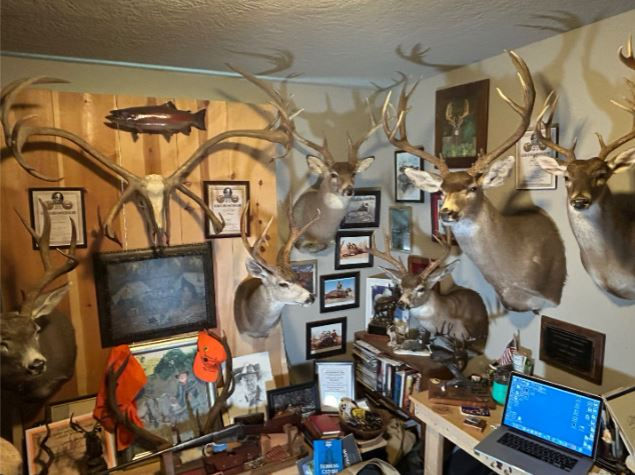
Our discussion started after inviting three individuals I had met through our DSC Summer Expo
to visit my office. They were impressed by the taxidermy mounts on the walls of my small
office. I explained the majority of my mounts from throughout the world, including full-body
mounts an African lion, Vancouver Island black bear, desert bighorn from Mexico and a
monstrous Alaskan brown bear were all on display at the Scheels store in The Colony, just north
of Dallas, Texas. “Before we moved to the “Land of Blue Bell Ice Cream” where we lived in
Uvalde, I had offices in our backyard and in town where hung most of my mounts. We
downsized when we moved to this our present home. My office shrank considerably. Most of
my mounts went into storage. Thankfully right after we moved friends at Scheels called and
asked if I had any mounts I would allow them to display in their new store.”
“Frankly I love the fact that now many people get to see those mounts rather than being
essentially hidden in my office. To me this continues a way to honor animals I have taken. It
tickles me when people visiting that store send me messages with a photos of particular
mounts under which are signs with my name and where the animal was taken. They often ask
me if I know where they are and want to know the story of the taking a particular animal.”
“I have shoulder or European skull mounts done to honor the animal. That’s the primary
reason for doing so. But, seeing the mounts help me recall every minute detail of the hunt that
lead to their taking.”
“That Coues whitetail, just above the plaque from the Jack O’Connor Hunting Heritage Center, I
shot hunting with Doug Mauldin back when he owned Derrydale Press hunting in Mexico. We
filmed the hunt for a Bass Pro show. Back then I was on the Bass Pro RedHead Pro Hunting
Team. Our cameraman was Mike Pellegatti. We hunted with Alcampo, owned by Javier Artee
and his family. The ranch straddled mountains on the Sonora and Chihuahua border. Our
cameraman was Mike Pellegati and I was shooting a Sako rifle chambered in 7mm Remington
Mag loaded with Hornady ammo. I later sold that rifle to my brother, Glenn.”
“Third morning of the hunt we spotted six does, two small bucks and that buck on the wall. The
bucks were chasing the does all over the ocotilla covered ridge. We walked a long way, then
crawled on hands and knees to where I could finally set up to shoot. Jorge Artee, did an
admirable job getting us within 200-yards. I set up my shooting sticks. The big 8-point started
walking away behind a wall of thorn bushes. Finally, he stepped into a clearing, stopped
broadside 250-yards away. I squeezed the trigger. My Hornady bullet hit him hard. He dropped
in his tracks.”
“He net-scored just short of the all time Boone & Crockett record book minimum score of 110.
But in my book, he was and remains a monster Coues deer.” After hesitating, while reliving the
hunt in my mind, I added. “Want to know what time of day, which way the wind was blowing,
the temperature, cloud cover, what I was wearing, the vaqueros’ names who were with us,
what we had for breakfast and supper the day I shot my buck, or just about anything about that
hunt…ask me. I’ll tell you!”
I heard one of the hunters say, “I’m starting to understand this thing about having mounts done
of the animals taken.”
Taxidermy is indeed a way to honor the animal and your memories associated with its taking.
But, you want to be certain the mount you have done looks like the animal you’ve taken, and
that the mount will last at least your lifetime and beyond!
During my younger years I was enthralled with and did my own taxidermy and I mounted
whitetail deer for friends. Then for several years I was part-owner in a taxidermy business
which was part of our Los Cazadores Hunting Headquarters in Pearsall, Texas. One of my duties
was overseeing our taxidermy business, including supervising several taxidermists and insuring
the quality of our mounts. I was then and am still a stickler for accuracy and details when it
comes to mounts. We sold Los Cazadores to the present owner back in about 2016.
The taxidermy studio that now does my mounts is Double Nickle Taxidermy
(www.doublenickletaxidermy.com) near New Braunfels, Texas. I chose them as a result of
much research and then spending time in their studio looking at mounts of several species.
In years past I spent considerable time hunting throughout the world. I almost always skinned
or helped skin and cape my animals. I wanted to see and learn about that species’ bone and
muscles structure. I also spent time photographing and studying live animals to learn their
behavior and postures.
Having been in the taxidermy business and having done taxidermy work myself, caped many
animals, plus having taken apart many animals as a professional wildlife biologist and
occasional hunting guide I learned much. In choosing a taxidermist I look for the attention paid
to details, including the expression and mood created by the mount’s eyes and ear
positions…the artistry of the mount.
In choosing your taxidermist visit their studio to see their quality of work. Questions to ask
potential taxidermist include: are capes actually tanned, how long should you expect it to take
to have your mount completed? Most taxidermists take a minimum of six months, and
sometimes longer. I live three hours from their studio. I generally drop off capes, antlers and/or
horns, and also pick up my mounts when they are finished at their studio. If you do not live
within driving distance find out how best to get/ship your animal’s skin and antlers/horns to the
studio. If you cannot pick up your mount when it’s completed, ask if it can be shipped to your
home and how.
If you’re going on an international hunt ask about what permits will be required to import your
animal’s skin, cape (head skin), skull or skull plate; ask if the taxidermy studio is licensed by the
USDA, what expediters they work with in the country you intend to hunt. Inquire if they have a
taxidermist they can recommend in the country your hunting to prep and properly prepare all
capes, skins, skulls, antlers and horns you will want shipped to your personal taxidermist. Ask
your taxidermist to prepare laminated cards that have the taxidermy studio’s address, special
permit numbers that might be required, your name and the expediter’s company name,
address and contact information. Ask the taxidermist to prepare at least five tags for every
animal you intend to take, plus some extras. Attach these tags via zip-ties to every skull, cape,
back skin or entire skin, and even individual horns for every animal you take before leaving the
hunt.
Regarding an expediter, who will handle the paperwork for getting your capes, skulls and horns
back to the States. Your taxidermist should recommend who they deal with.
As a whole there are many good taxidermists around, and, a few great ones. Cost of mounts is
always a consideration. But, don’t let it be your only consideration. Well done, accurate,
attractive mounts last a long time, long after any sting of the fees paid to have them done have
passed.
Taxidermy in recent years has seen tremendous advances in quality, but it is still truly an art,
taking the regimens of numerous sciences and combining them in proper amounts to create the
finest and best mounts.
With taxidermy concerns taken care of, load your favorite Taurus or Rossi rifle topped with a
Stealth Vision scope or Taurus Raging Hunter topped with a Stealth Vision red-dot sight with
Hornady ammo and go hunting!


Comments