

Take Me To The Gar Hole! - Larry Weishuhn
- Jeff Rice
- Jun 18
- 12 min read


Our trotline was stretched across Cummins Creek, tied to willow trees on opposite bank. For
four days our usually slow-moving creek had been on a “rise”. Flood water had finally started
subsiding. Flooding run-off had not only covered the entire bottom of my grandfather’s
property, water backed up from where the creek flowed into the Colorado River. Said Grampa
Aschenbeck in German, loosely translated to, “When the creek rises, big long-whiskered yellow
catfish and gaspergoo swim upstream.”
In hopes of catching catfish and fresh water drum we had alternately baited the staved hooks
with chicken liver and hand-sized “perch”. Trotline baited, in German Grandpa suggested the
equivalent of “Lets go have supper. We’ll come back just before dark to check the line.”
I was as hungry as a red-haired, freckle-faced, six-year old barefooted boy could possibly be. I
ate fast, asking about “running the line” at least twice every three minutes. My granddad
smiled. I suspected he was equally anxious.
The sun beaming, after a week of torrential rains and ashen overcast skies, started sinking. We
headed to the creek. Our flat-bottom cypress plank boat was tied to a tree upstream of the
trotline.
Grandpa Aschenbeck noticed our trotline was no longer attached to the willow tree on the
opposite bank. “Nein, das ist nicht gute!”
Me? I knew it had to be a 200-pound catfish that had broken the line.
Grandpa stuffed me into an oversized life preserver. I looked and felt like the “Pillsbury
Doughboy”. Then, he thought the better of getting into the boat. The line was no longer
secured to the opposite bank. We could pull it from our side. The first two hooks both held
fish. Hook No. 1 had a five-pound yellow catfish. The second hook was attached to a slimy,
three-feet long freshwater eel.
Something jerked the line out of our hands. We grabbed it and started pulling. It felt like was
hooked to the bottom. Then, whatever we were hooked on to started moving. Holding on, I
recalled Hemingway’s “Old Man and the Sea”. My mother had been reading it to me at night.
Maybe, it was a huge marlin, or shark! We pulled, give and take, for 5-minutes, holding on
more than gaining line. Finally, we started gaining line.
The water was really muddy. We could not see what was on the other end. Whatever it was
had to be huge. The line went slack. Whatever it was was swimming our way.
“It’s coming up to jump!” blurted my granddad, this time in English. A monstrous fish started
coming out of the over-creamed coffee colored water. A broad snout not unlike an
alligator…followed by a long, thick, scaly, cylinder shaped body. It seemed to take a full minute
for fish to fully clear water. My jaw dropped. I released the line and fell backward. I could not
believe my eyes. The monster fish’s mouth opened revealing long rows of spike-like teeth.
An alligator gar, at least 8-feet long, twisting and turning while fully out of the water. The
monstrous gar jumping reminded of photos I had seen of tarpon, only many times bigger and
more impressive.
The giant gar fell with a huge splash, drenching us with creek water. It started swimming up-
steam. The line stretched taunt, then broke. The huge gar was free, gone.
I looked up at my granddad. His eyes were wide. I knew mine had to be. In German he
explained, during a lifetime of fishing the local rivers and creeks he had seen a lot of big
alligator gars, but this one was the biggest by far!
The sight of that huge alligator gar clearing water remains a memory as vivid as if it happened
yesterday, though now more than seventy years ago. I knew back then someday, someway I
would catch a monster gar or at least try!
Years later, freshly graduated from Texas A&M University with a wildlife science degree
working for Texas’ Wildlife Disease Project… That particular summer I spent much time with
fellow wildlife biologist David Rideout working on a raccoon disease project. While catching live
‘coons at night in the Navasota River bottoms we heard hundreds of croaking bullfrogs. State
salaries back then were just shy of mere subsistence wages. With chores done for the day,
David and I decided to augment our table fare with frog legs. A quick call to the landowner
gained permission for us to “gig” frogs.
David at the time had an eight-foot long fiberglass canoe, ideal for navigating the ox-bow lakes,
part of the Navasota River watershed. We loaded the canoe, a “croaker sack”, two frog gigs,
and a couple of headlamps, then headed to oxbows along the Navasota.
On the water, we paddled silently gliding from one frog to another. At nearly the end of the
head lamp light’s penetrated darkness we spotted a huge bullfrog sitting on a nearly
submerged tree trunk. Cautiously we paddled toward it. David was about to grab it, when our
boat was rocked by something. Shining our lights starboard, we saw a huge dark form rising to
the top of the water. It was as wide as our canoe, and, longer by at least a foot. We froze.
My first thoughts were there really were some truths to the long touted Navasota River
Monster stories. But then I recognized it as a huge alligator gar, based on its scales. The
behemoth gulped air, rolled forward and disappeared into the dark water. “Did you see
THAT?” asked David, his voice many octaves higher than normal.
“I did! That was an alligator gar the size of which I did not know existed! He had to be ten-feet
long, and wider than the canoe!” We decided we had sufficient frog legs and saw no reason to
continue looking for more.
Later that night we devised a plan. Come the weekend I would bring a salt water fishing rig and
David his bow. We were going after the daddy of all alligator gars.
The big gar lived in a relatively narrow, though deep, previous river channel, an ox-box lake,
separated from the river by dry land. The big gar was trapped there. It could not get out of
that body of water, unless it walked on land!
The morning after seeing the big gar it started raining, pouring! It rained so much the both the
Brazos River and the Navasota River flooded beyond their banks. Water covered the the entire
flood plain. We hoped the big gar would stay in its oxbow.
When the flood subsided we spent several days and nights on the oxbow. Evidently the
monster gar returned to one of the rivers when high water allowed. Surely would have liked to
have caught that one to measure and photograph it before releasing it.
Alligator gars are remnants of the Cretaceous Period. Their kind has changed little if any over
the past 100,000,000 years. As my hunting and fishing partner, Luke Clayton, says “Why would
Mother Nature mess with or change perfection?” In many ways alligator gars are perfect.
Broad-muzzled gars can and do eat just about anything they want including: fish, reptiles,
amphibians, birds and small animals.
Toothsome? Gars have over 500 teeth. Those in the lower jaw fit into the valley between two
rows of upper teeth. They use their impressive needle-sharp “dental work” to seize and hold
prey/food, rather than for ripping and tearing. Gars hold, then swallow their food whole. Their
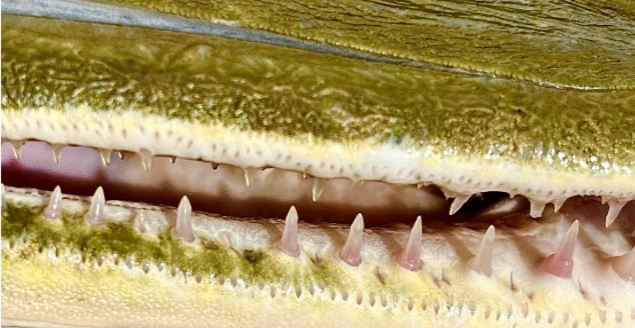
muzzle, which indeed is reminiscent of an alligator, has a special adaptation allowing it to
expand so they can swallow large prey. In spite of their ferocious appearance alligator gar pick
up and gingerly hold food in their mouth, occasionally for a long time before swallowing it.
Something I learned the hard way early on in attempting to set the hook as soon as I felt a
“bite”.
These remnants of the dinosaur age are a freshwater species, but can and do occasionally stray
into brackish water. Interestingly too, they have a “swim bladder” which allows them to
breathe air. Gars regularly surface or “roll” to gulp air. This is one of the ways you know you
are in a “gar hole”, seeing and hearing gars “roll”! This truly unique fish has large eyes and an
excellent sense of smell typical of predators, making their kind ever more intriguing.
How big do alligator get? They are North America’s largest freshwater fish. IFGA records credit
the largest all tackle record at 229-pounds caught in the Rio Grande back in 1950’s. However,
there are “claims” of a guide boating one over ten-feet long from Texas’ Trinity River in 1991
weighing 365-pounds! There too, are vintage photos of huge alligator gars from other states,
that appear to be at least that big if not bigger, but were never weighed on scales.
At one time, alligator gars were considered “rough fish” with no regulations regarding bag
limits. Too, at one time bowfishing for big gars was extremely popular, accounting for the
taking, meaning “killing”, of many huge gars. Today, thankfully, most states have size and bag
limit restrictions. Alligator gars are making a comeback. Numerous who previously bowhunted
gar are now fishing for them, especially guides who have come to realize a huge gar can be
killed once, but if caught on fishing tackle they can be released to caught again, and, in doing
so, allowing them to spawn and perpetuate the species.
Going back to my younger days, after seeing those two monstrous gar I have long wanted to
catch one measuring six or more feet in length. I had a chance at a truly monstrous gar a few
years ago while fishing a shallow, long, wide flood-control drainage ditch in the southern tip of
Texas near the town of Port Mansfield. The “ditch” drains into the Gulf of Mexico. From a
bridge connecting both sides of the ranch we were on, I spotted numerous big muddy spots
where gar were feeding. I baited a “heavy rod and reel” with a two-inch square of cut carp and
cast it up-current of the biggest muddy area. I waited for the bite. It happened a short time
later. As the gar moved, I fed out line. The gar steadily swam up stream. It stopped for about
thirty-seconds before turning and swimming downstream, I waited for the fish to stop. When it
did I quickly reeled in slack. The line was taunt. I stoutly set the hook. The gar shook, then
swam rapidly downstream, stripping line. I ran along the bank to try to keep up with it. It
turned and swam up stream. I reeled as fast I as I could! The fish stopped, shook violently then
hurled itself airborne, fully clearing water. No doubt it was over 7-feet in length. Back in the
water, she (most all big gars are females) again swam downstream. I tighten the drag thinking I
could slow down or stop her. Wrong! Bad mistake, I should have let her run. My 80-pound
test line broke. My gar was gone! “Should have’s” do not catch big fish!
Losing that big gar, I wanted a big one all the more. An opportunity finally came when I was
introduced to Chris Moody with Gar Fishing Addictions (www.garfishingaddictions.com). Luke
Clayton and I fished for crappie with him. My biggest and best crappie fishing day ever. I knew
Chris’ reputation for catching monstrous-sized alligator gars, I wanted to gar-fish with him.
Chris spent his younger days guiding bowhunters to huge alligator gars by day and following
‘coonhounds at night. Thankfully, he was one of those guides who early on realized the
importance of fishing for alligator gars with stout tackle rather than killing them with an arrow.
His reputation of putting clients on big gar grew in leaps and bounds, including taking the host
of Discovery Channel’s “River Monsters” fishing for monster gar. Not only fishing for, but
catching huge gars. Chris regularly fishes the Trinity River southeast of Dallas, Texas, a river he
now knows better than the back of his hand, and where a reputed 10-feet plus gar had been
caught in 1991.
The day Luke and I fished for crappie with Chris he explained he had a limited number of days
available during summer’s peak gar fishing time. I wrote and handed him a deposit check for
my daughter, Theresa Tigrett, and me to fish with him.
Theresa and I kept up with Chris’ successes through social media, numerous photos of five to
over seven-feet long gar caught and released by his clients. We could hardly wait to fish with
Chris.
We met Chris at his appointed jump-off and stepped aboard Chris’ comfortable boat specifically
rigged for gar fishing.
“Want to start near where we recently hooked and lost an eight-footer. Huge fish. We had her
right next to the boat. I was preparing to put the rope around her when I saw she was barely

hooked. Before I could do anything she shook her head, threw the hook and was gone!”
explained he as we headed downstream.
When we stopped, “We’ll put out six lines. Do not set the hook when the float starts moving,
give the fish line. Gars carry the bait in their toothy mouth a while before swallowing it. I’ll tell
you when to set the hook.” He continued, “The water is up at bit, but not a problem. I’ve fished
this stretch a lot, plus, will use electronics to find fish. At this first spot if we do not catch a fish,
or see five-feet or better gars on the graph, we’ll move.”
Moments later one of the floats started moving. “Theresa, you’re up!”. She grabbed the rod.
Chris and I reeled in the others.
“Let her run with the bait!” instructed Chris. The fish had made three short runs, and stops, as
it started the fourth run Chris said, “Set the hook, hard!” Followed immediately by “Start
reeling, rod up high.” The battle was on.
Theresa fought the fish like a pro! I watched the rod shake each time the fish shook its head.
“Good fish!” commented Chris, “Should be over 5-feet!” Theresa was too busy fighting the fish
to comment! Blurted Chris, “She’s gonna jump!”.
I had been recording the action with video camera for an episode of “A Sportsman’s Life” which
I co-host with Luke Clayton and Jeff Rice. Our “real world hunting and fishing show” airs weekly
on CarbonTV.com. I caught the better than five-feet long gar clear water in a manner that
would have made a tarpon jealous! I heard Theresa say, “Oh my gracious!”. Moments later the
huge gar jumped again. Theresa pumped the rod, taking line on the downward movement. I
glanced at a smiling Chris Moody, who was nodding in a positive manner!
“She’s wearing down… Start bringing her alongside so I can get a noose around her and we can
bring her on board. Remember to stay clear of the head and teeth when we do.” With that
Chris placed and tightened the rope just behind the gar’s pectoral fins, then started pulling her
aboard.
“Wow…They do fight!” Said my excited daughter, followed by “My biggest fish ever!” I no
doubt smiled broadly. Theresa had properly fought the big fish. I could not have been prouder
of her nor more pleased. Even if I did not catch a gar, our trip was already a huge success!
Looking closely at her gar Theresa noted, “Oh look, she’s tagged!”
After photographs we recorded the tag number, then slid the great fish back into the river. “OK
Dad, the next one is yours!”
Heading toward another stretch of the river, Chris explained he and other gar guides, under the
guidance of the Texas Parks and Wildlife Department’s Fisheries Division, were tagging alligator
gars to learn about age, growth and movement of tagged fish. Later we learned Theresa’s gar
had been tagged six miles up river, a couple of months earlier.
My chance at a big gar came when we stopped the boat where earlier in the week had been
hooked and lost an 8-feet long fish. Six lines out; five baited with an inch-thick cross section
slice of a six-pound carp. The sixth was baited with a carp head. “Big gars like carp heads.”
Commented Chris.
No sooner had we cast all six rods, one of the floats started moving upstream, the one baited
with the carp head. “Expect a good fish. Bigger gars tend to swim upriver.” Said Chris, then
added, “Let her run, I’ll tell you when to set the hook!” A couple of short runs later, “Wait till
the float stops. When it starts moving again, reel slack…Remember gar have really tough
mouths…” Moments later, “Set the hook!”
The line tightened, I jerked back hard and Immediately started reeling. The gar headed
upstream! Each time she stopped I could feel her head shake. It felt like a big fish! My largest
to date fresh water fish was a blue catfish which tipped the scales as 74-pounds. This one felt
bigger!
I started taking in line when Chris maneuvered the boat toward the fish. I watched where my
line disappeared into the muddy water. The line started coming out of the water. “He’s going
to jump!” The huge gar cleared water. Behind me I heard Chris say, “She’ll go at least six feet!”

“Got the jump Dad!” said Theresa, now filming. Moments later my gar jumped a second time.
“Keep playing her! When she’s ready to be brought on board, I’ll put the rope around her!”
instructed Chris. My gar was putting on a truly tough and tenacious fight.
A few minutes later Chris suggested to bring her along side the boat, slipped a rope around her
and we pulled my gar on board. Finally, I had caught a six-foot-plus gar, a lifetime goal. After
some photos, measurements and tagging we released my catch back to her river home.
A little while later Theresa caught a second gar, one Chris referred to as a “youngster”, although
a bit over four-feet in length. It too, jumped like a tarpon. Fish released, Theresa beaming,
“You’re up again Dad!”
An hour later, I waited until Chris told me to set the hook on a gar headed upstream. When I did
it was as if I had hooked the bottom. The fish rapidly swam up stream. “She’s a biggun!” said
our guide. “Hang on!”
That was all I could do. The fish stripped line at an alarming rate. I looked in the direction the
big gar headed. That is when she jumped! She was huge, far bigger, longer and wider, than
anything we had caught. I could see the baited hook grasped in her toothy jaws. Near the top
of her ascent she opened her mouth. The baited and hook fell free.
Immediately I realized three things. I had not taken a breath since I had set the hook, she had
merely held the bait in her mouth, and, now she was no longer on the end of my line.
“That Sir, was a monster alligator gar, likely eight-feet long…” said Chris shaking his head.
That evening I handed Chris a deposit for a couple more days fishing for big alligator gars next
summer. My quest for another monster alligator gar will continue. I can hardly wait!


Comments